Symptoms that clear up when you leave the house? That’s worth investigating. MoldGone inspects HVAC systems and indoor air across DC, Maryland, and Northern Virginia. Call 240.970.6533 or schedule an inspection.
You’ve been to the doctor. Maybe twice. You’ve done a course of antibiotics, or a steroid spray, or an antihistamine that worked for a while. The congestion cleared, and a few weeks later it came back.
At some point the question stops being “what’s wrong with me” and starts being “what am I breathing.”
Almost nobody investigates that one. Your physician evaluated your body. Nobody evaluated your air handler. And in a lot of DMV homes, the air handler is the wettest piece of equipment in the building.
The Short Answer
Your air conditioning system is designed to make water. The evaporator coil runs cold, moisture condenses on it, and that water drips into a pan and drains away. When the drain fails, you get standing water inside the equipment that blows air into every room in your house.
Mold needs moisture and a food source. A wet drain pan in a warm basement, with dust and organic debris collected on the coil, provides both. If growth establishes there, the distribution system does exactly what it was built to do: it distributes.
That’s the mechanism. Here’s how to tell whether it applies to you.
Why the Air Handler Is Different
Mold in a bathroom stays mostly in the bathroom. Those problems are local until something disturbs them.
Mold inside an air distribution system is not local by design. Every cycle pushes air through the coil, into the supply trunk, and out to every register the system serves. Whatever sits on that coil is upstream of every room in the house.
That’s why these problems present so strangely. No visible growth on a wall, no obvious water stain, and symptoms that are everywhere and nowhere. It’s easy to write off as seasonal allergies or a run of bad luck with head colds.
The Mechanism, Step by Step
The coil is cold and wet on purpose. Refrigerant runs through the evaporator coil and drops its surface temperature below the dew point of the air passing over it, so water condenses out. That’s not a malfunction, that’s how air conditioning dehumidifies. In a Mid-Atlantic July, a residential system pulls a serious volume of water out of the air every day.
The water has to go somewhere. It drips off the coil into a condensate pan, then out a drain line, either by gravity to a floor drain or exterior discharge, or by a condensate pump if the equipment sits below the drain point.
Then the drain fails. This is the common failure and it happens in a few predictable ways:
- A clogged condensate line. Biological slime builds up inside the PVC drain line over years and eventually blocks it. It’s the most common drain failure we find.
- Improper slope. The line was run flat or slightly uphill during installation, so water sits in it instead of draining.
- A failed condensate pump. The float sticks, the motor dies, or it’s unplugged, and the pan simply fills.
- A rusted or cracked pan. Water escapes into the cabinet or the platform underneath instead of draining.
Now there is standing water inside the air path. A pan that doesn’t drain is a shallow reservoir sitting in a dark, warm enclosure, downstream of a filter that has been catching skin cells, pet dander, drywall dust, and pollen for months. Moisture plus an organic food source is the entire recipe. Once a colony establishes on the wet fins, in the pan, or on the insulation lining the cabinet, air passes directly over it on the way to your bedroom.
The Other Three Contributors
The coil and pan are the headline, but they aren’t the only failure points.
Duct insulation. Older DMV systems frequently use flex duct with an interior liner, ductboard, or internally lined metal trunks. That interior surface is porous and it collects dust. If it ever gets damp from a leak, a humid crawl space, or condensation on an under-insulated attic run, it holds that moisture in a way bare sheet metal does not. Ductboard that has been wet is difficult to clean and often has to be replaced.
Filters. Two problems here. A loaded filter that hasn’t been changed becomes a damp organic mat when humidity is high. And a filter that fits poorly, or a rack with gaps, lets air bypass the media entirely and deposit debris straight onto the coil. Bypass is common and almost never noticed.
Return-side leaks. If the return ductwork or the air handler cabinet has gaps, open joints, or an unsealed platform return, the system pulls air from whatever space it sits in. If that space is a vented Northern Virginia crawl space or a musty Maryland basement, your system is drawing that air into the supply stream and delivering it to the bedrooms. You can have a clean coil and still have a distribution problem, because the contamination is being pulled in by the return rather than grown on the equipment.
DMV note: This region stacks the deck. Summer dew points across DC, suburban Maryland, and Northern Virginia stay high enough for months that residential systems run long, wet cycles from June into September. The housing stock is old, so plenty of air handlers are original or one replacement in. And placement is the real issue: equipment here sits in finished basements, unconditioned attics, and crawl spaces, which means the machine that makes water usually lives in the dampest part of the house. A system in a conditioned closet in a dry climate never faces that.
Test It Yourself: A Self-Assessment
None of these prove anything on their own. Together, they tell you whether the air in your house is worth investigating. Treat this as a signal list, not a diagnosis.
- Do your symptoms improve after a few days away from home? The most useful single question. If you feel noticeably better by day three of a trip and it returns within a day or two of getting home, the building is a variable worth examining.
- Are you worse in the morning? Waking up congested, with a sore throat or a headache, after sleeping in a room with the system running is a pattern worth noting.
- Is one room worse than the others? A bad register, a run through a wet crawl space, or a disconnected duct can make one bedroom distinctly worse than the rest of the house.
- Do symptoms spike when the system first kicks on for the season? The first hot week in May, or the first real cold snap, blows out whatever has been sitting in the system since it last ran.
- Is there a musty smell at the supply vents? Stand under a register when the system starts and take a breath. Earthy, musty, or “wet towel” is meaningful. A brief burnt-dust smell on the first heating cycle is normal and different.
- Is anyone else in the house affected? Including pets. When two people in a household have the same lingering complaints, a shared environmental exposure moves up the list.
The honest framing on health: mold exposure is a recognized trigger of allergic and upper respiratory symptoms, and the EPA, CDC, and WHO all treat damp indoor environments as a legitimate air quality concern. That is not the same as saying mold caused your symptoms. It means that when symptoms track with being in a building, the building is worth checking.
What to Physically Check
You can do all of this yourself in twenty minutes without tools.
- The condensate drain line. Find where it exits the air handler and follow it. Is water actively draining during a cooling cycle? Is a secondary or emergency drain line dripping? A dripping secondary means the primary is blocked.
- The drip pan. Look for standing water, rust staining, mineral crust, or slime. Water sitting in the pan while the system is off is a problem.
- The filter. Pull it. Note how loaded it is, whether it’s damp, whether it sits tight in the rack, and whether anyone wrote a date on it. If you can’t remember the last change, that’s your answer.
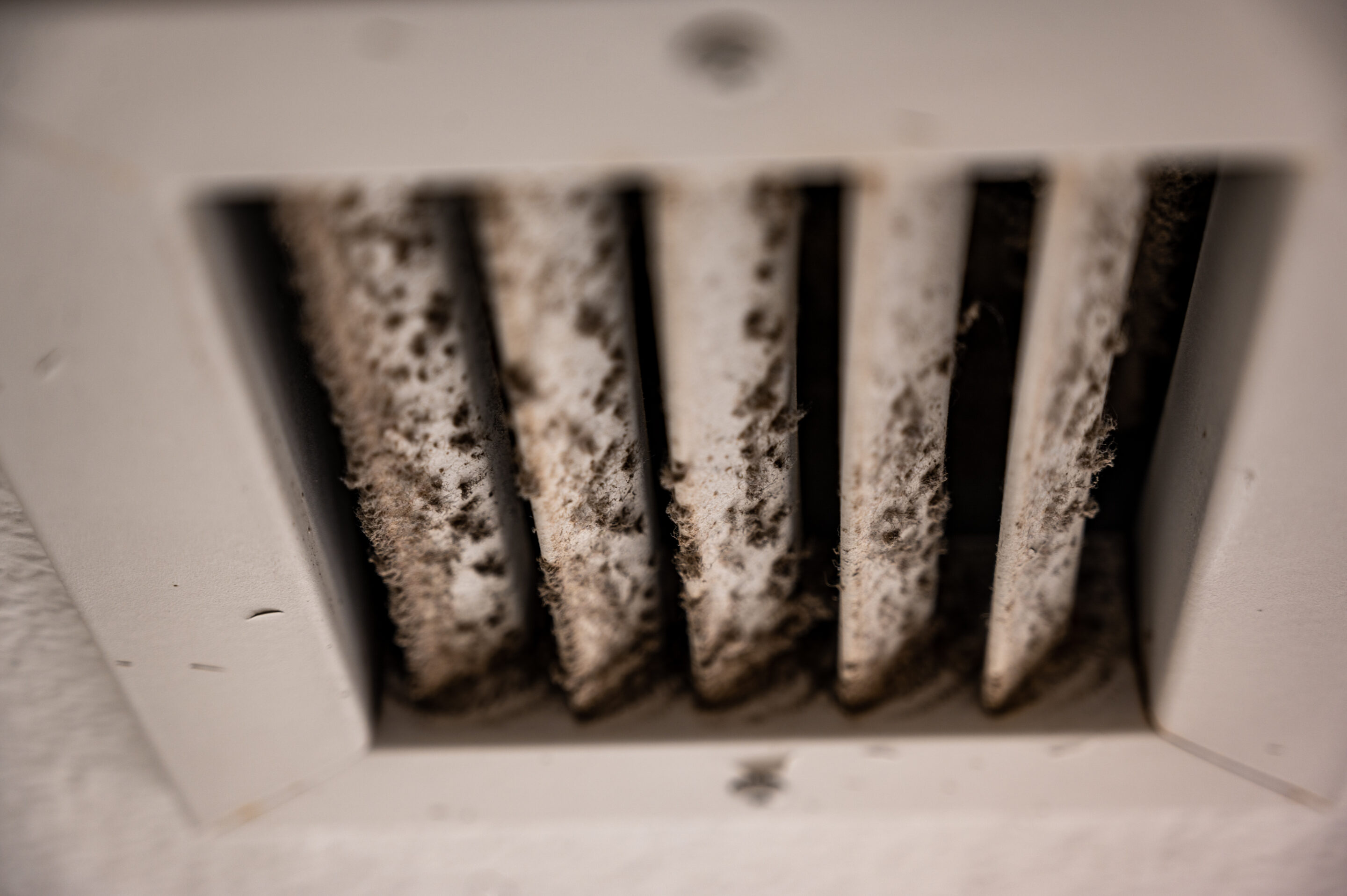
- The supply registers. Pull one or two and look inside with a flashlight. Dark speckling on the register, the boot, or the first few feet of duct is worth documenting.
- The equipment’s location. Basement, attic, or crawl space? Is the surrounding area damp, musty, or stained? Does the insulation on the platform look water-marked?
Take photos of anything you find before you touch it.
Duct Cleaning Alone Does Not Solve This
This part matters. If there is growth in your system because water is sitting where it shouldn’t, cleaning the ducts removes what’s there now and changes nothing about why it grew.
The coil stays wet. The pan stays full. The crawl space keeps feeding the return. In a few months you’re back where you started, with the same symptoms and the same question.
The sequence that works is: find the moisture source, confirm what’s growing and where, correct the water problem, then clean or remove the affected components. Assessment comes first because you cannot scope a remediation you haven’t measured. Testing has a real role here too, particularly in this exact scenario, where there’s no visible growth to point at and the whole question is what’s in the air. Handling all of it under one roof, from assessment through verification, is the difference between a fix and a repeat.
The Bottom Line
If you’ve treated the same congestion and sinus symptoms more than once and they keep returning, and you feel better away from the house, the air handler deserves a look. It’s the one place in the home where water is produced on purpose, and the one system that delivers whatever it contains to every room you sleep and breathe in.
Check the drain line, check the pan, check the filter, and pay attention to whether your symptoms track with the building. If they do, get the system and the space around it assessed before the next cooling season loads it up again.
MoldGone handles inspection, air quality testing, moisture source identification, and remediation across DC, suburban Maryland, and Northern Virginia, including HVAC-related contamination and the crawl spaces and basements that feed it.
Symptoms that keep coming back and no explanation? Call MoldGone at 240.970.6533 or schedule an inspection.
This article is general information about indoor air quality and building conditions. It is not medical advice, and it is not a diagnosis. If you have persistent sinus, respiratory, or allergic symptoms, see a physician. Raise your home environment as part of that conversation, and let a doctor evaluate your health while a qualified professional evaluates your building.